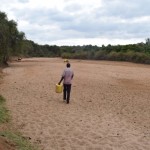
TWP catch up with Kakiring Community in Northern Kenya

Monday, May 14th, 2012

Posted by Jack Owen, TWP WASH Program Manager. 14 May 2012

I spent most of last year living in Kenya. A lot of that time I was working directly with our partner organisations, working through program strategies and contributing to project proposals. It was a very fruitful time, and led to new relationships as well as the strengthening of existing ones. As well as the office based work, I also spent a lot of time on the road, visiting projects, talking to communities and trying to get a genuine sense of the impact our work is having.

This is Elizabeth, a member of the community at Kakiring.

Whenever I think about impact, I think about Kakiring. The people of Kakiring village, a few kilometers south west of Lodwar, are inspiring. I first travelled the long and bumpy road from Kitale to Lodwar in 2010, on a feasibility study for one of our partners, Bridge Water Project. I had been living in Kakamega, Western Kenya, and helping to restructure the project when the opportunity came up to travel north. I jumped at it. An old gentleman called Geoffrey was looking for partnerships to help him support the people of Kakiring, and I agreed to travel with him to meet the people and take a look.

The days I spent there 2 years ago have never left me, and so when I was in Kenya last month I made it a priority to pay Kakiring a visit, and confirm that the borehole and hand pump scheme we worked on last year was serving the community and that the people were able to look after it correctly.

The handpump in use at Kakiring

It was fantastic to see. The pump was serving the people of Kakiring as well as the neighbouring villages. The 3 hour walk to the river was no more, and people looked visibly healthier. Children’s faces were shiny where once they were dull, and there were places to discreetly have a bucket shower behind every hut. I was welcomed like a true friend. We ate githerie (maize and beans) under the stars, and danced to the beat of the drum until the moon rose high into the night sky. There was a sense that things were getting better in Kakiring, and an energy that comes from achieving something tangible.

Jackson Ewoi and myself catch up after a long time!


The overflow from the borehole had been encouraged into a channel which led into a fenced plot ready for cultivation. These semi nomadic pastoralists were thinking of planting. A first tentative step away from the reliance on food aid that is the norm in this part of the country.

Everyone talks about impact all the time, and struggles to quantify it. Numbers served, diseases reduced or eliminated. Children in school. Dishracks, washing lines, and latrines in homes. Income generating activities. All of these are indicators of positive impacts that water, sanitation and hygiene projects can achieve. And I think about all of this too, but sometimes when I think about impact, I just think about Kakiring, and the genuine relief written all over the faces of those whose lives have been transformed through access to a functioning handpump.

What the future holds is not clear for such marginalised peoples, but it is great to see Kakiring pull together, look after their supply successfully, and start to make plans for the future that are based on the goal of self sufficiency.

I’ll be back there soon I hope, and look forward to working with the people as they take the next step forward.


Chats with Jack – Monthly Calls with Colleges and Universities

Wednesday, January 18th, 2012

Tess with children in Rwanda; see the woman carrying water in the background?

In the late autumn of 2011 we started meeting via Webex each month with students from colleges and universities all over the country.  Our goal?  To connect them to other like-minded peers and leaders who are interested in being a part of the solution to the economic water crisis that keeps millions without access to clean, reliable water sources.

In December we began recording the calls; I tell you, this is so fun!   So why bother doing the recording?  So we can share news from the field, and begin to catalog conversations that others (like you) can listen to and learn from, at your leisure!

Jack, the voice from the field

For our December call we had an interview with Jack Owen, our Program Manager, where we heard about a pilot project we are beginning in Kenya with a Field Partner, Pamoja Trust.   Working in informal urban settlements around Mombasa, the pilot project will establish two water kiosks, provide hygiene and sanitation training, and is expected to serve between 2500-3000 people.  Listen to our chat with Jack by clicking this link, and hear more details about this project, and stories of changed lives.

What’s next in our line up of recorded topics?  Keep your eyes open for topics such as ‘Time is Money Water!’ (to be recorded during our Jan. 25th call),  ’Technology Spotlight’, and others.  Have ideas for discussion topics?  Write to us!  We’d like to hear from you.

“Catch you on the radio”, as they say!


Smiles are only the beginning

Wednesday, September 28th, 2011

The most amazing this about this photograph is that it doesn’t even begin to tell the story of what will happen in this place.

Yet, so often, we get caught up in images like these. Don’t get me wrong, there is every reason to. The first drops of clean, safe water for a school bring dramatic and immediate changes.  In an instant, children – often young girls – are freed from the daily burden of carrying water from a far away stream or infested pond. Water is used for washing and cleaning, restoring dignity and pride. Crops are irrigated and parched plants begin to show new signs of life as the fear of hunger subsides. Stomach aches fade and soccer games take on a new found energy. Childhood resumes.

But it’s the unseen that is truly remarkable. When you step back for a moment, another image emerges.

When I gaze into these faces, I see the future. I see young men and women engaged in learning. I see healthy, rested minds hard at work. I see this young girl, Purity, with time to dream about what she’ll be when she grows up. I see a market stand opening, packed with vegetables and crafts – products of fertile fields and productive hands. I see a leader, Steve, inspired by what someone did for him, yearning to help his own neighbor escape poverty.

I’ll admit though, I still get caught up in the moment. Water flowing, children splashing, and everyone cheering the opening of a new well will do that. In our narrowly focused world, we’re so used to goals and accomplishments. We love to celebrate what is “finished.” But if we stop there, we’ll miss the fullness of what is happening.

So let’s not forget that today is day one. The hard work of the next steps begin now. Hope is only beginning to bear fruit.

Then, when we celebrate with a community or a school like this one, we can celebrate things that we’ll likely never see – future events that we’ll certainly not have a hand in. We can celebrate Purity’s graduation from high school. Or Steve’s successful new enterprise, fresh out of university. We can cheer as a new school is constructed or as the local church fulfills its mission and raises nearby villages from poverty. We can celebrate things we cannot even imagine.

That’s what it means to join in their story. That’s what it means to hope for Steve and with Purity, and all their friends at the Care Compassion Orphanage.

When water comes… everything changes. These smiles are only the beginning.

What do you see?

Changamwe urban sanitation project taking shape!

Wednesday, June 8th, 2011
I’ve been spending quite a lot of time with a men’s support group in Changamwe recently, an informal urban
settlement on the main Nairobi road out of Mombasa.

David and Herbert, members of Changamwe Men's Support Group at the proposed site

They have developed a proposal for a sanitation block in their community, involving three or four flush toilets and
a shower. The idea is that people will pay per use of the facility, and through this the group can raise funds for
another similar project in the future as well as provide support for AIDs affected families in the community.
The site is small, around 5m by 3m, but ideally located to the main road, and right next to the municipal water line
and the sewerage network. The group are also keen to include a community space in the project, to allow them to facilitate HIV awareness events and hold Voluntary Community Testing (VCT) evenings.
As well as support from TWP, the group are also working closely with Women Fighting AIDs in Kenya (WOFAK), a well established respected NGO with substantial experience of working in slum settlements in Kenya.
At this point we’re in the discussion stage, and are committed to facilitating the design process and workshop sessions. When we have some coherent plans and a decent proposal, we’re also very keen on the idea of funding the construction process, and as such entering into the world of urban water and sanitation. At the same time, TWP is talking to WOFAK about on – going support, and about ensuring that the group have the capacity to handle their income and maintain the facility in the long run.
Good, exciting, progress. Watch this space!


Sand dams and other miracles

Tuesday, May 3rd, 2011

In some areas of Kenya – like where I live in Coast Province, finding clean water is almost impossible. With little rain and salty groundwater, people travel for miles with jerry cans to find fresh springs or river beds where they can dig for water.

For us, the question is often not “Do we want to help?”, but rather “Can we work out a way to help?”. And by implication, do we have the partners who can work in such challenging conditions? As you may be aware from earlier posts, part of my work this year is about partner development. I’m currently on the hunt for organisations that The Water Project can partner with in the future. This is a tricky assignment for me, and three months in to my year here, I’m realising that it is a slow process. It’s important we take the time to hear the inside story and make sure we do due diligence. We need to make sure we are giving our donors genuine value for money, as well as serving communities in the best and most sustainable manner possible.

To date, the partners we have are ‘well’ focused (excuse the pun!), in that they base their implementations on boreholes or hand dug wells, but as I’ve mentioned, this approach is not always appropriate. As such, another focus of this year is to try and diversify the approaches we fund. Each development situation, each community, is different and  it’s vital that we (and our partners) are able to think creatively when tackling WASH issues.

(more…)

Addressing urban WASH issues in Informal Urban Settlements

Thursday, April 28th, 2011

Yesterday I visited an Informal Urban Settlement in Mombasa, in an area called Likoni. Informal Urban Settlements, or slums, are areas characterised by poor housing and squalor, where the population lack official land tenure rights. Globally, more than 1 billion people live in slums, a figure that is rising all the time as people move to cities in search of employment.  Water, Sanitation and Hygiene (WASH) issues are typically very challenging, as people lack access to clean water, and waste disposal (either of human excrement or household rubbish) is haphazard and unregulated.

Yesterday I visited Khasim, (more…)

Are Water User Associations working?

Tuesday, March 29th, 2011

I recently had a meeting with a local NGO here in Coast Province called Community Link International. They are a small and embryonic team, primarily made up of Margaret and Musyoka, with a couple of part time field staff. They’ve been registered as an NGO for about a year, but can collectively draw upon a couple of lifetime’s experience within development.

After graduating with a Sociology degree, Margaret spent time working for Amref in Lodwar, UNICEF in Nairobi and the Aga Khan Foundation in Mombasa, as her career progressed over the last 20 years. Musyoka chose a different path, spending 15 years in government before joining Margaret a few years ago at Aga Khan on a USAID funded WASH program. Together they have a lot to say –  about what they’ve learnt over the past 20 years, and about where they think the focus should be in future WASH policy.

(more…)

World Water Day – a time for reflection

Tuesday, March 22nd, 2011


Today is World Water Day (http://www.worldwaterday.org/), the annual global day of events that grew out of the United Nations Conference on Environment and Development (UNCED) in Rio de Janeiro in 1992. The focus changes every year, with the theme this year  titled ‘Water for Cities’. The last 20 years has seen a massive shift in population trends, to the extent that in 2008 the rural / urban population split was 50 / 50 for the first time. Movement to urban centres in search of employment and with high ideals (more…)

What is this ‘sustainability’ thing, anyway?

Tuesday, March 15th, 2011


Ever wondered what sustainability means? People use it a lot in our line of work, usually when thinking about the IMPACT development work has. I thought I’d try and go for a definition today as I sit here thinking about how to get more of it! Interested? Have a read of this and tell me what you think!  (more…)

Northern Kenya – The Road to Turkhana

Tuesday, March 1st, 2011

Since I last posted, I’ve been over to Western Kenya to visit our partner Bridge Water Project. It’s been great to visit old friends, and to get involved in the day to day activities of a local development organisation. I’ll try and post a longer piece on some of the things we got up to whilst I was there another day, because for now I want to write about where I am now, just outside Lodwar Town in Northern Kenya.

Lodwar is the last large outpost before the northern border of Kenya, Lake Turkhana and the lands of Sudan. It is dry here. The Turkhana People who live here are traditionally pastoralists, herders of cattle, goats and camels. There has been a drought here for the last 10 years, so most of the cattle have died.  People rely heavily on the substantial aid presence here for food and relief, as without water little grows in the sandy ground. All the large well known aid organisations are here – it feels more like a disaster response than a developmental scene. People thinking of Kenya as the lush green of Western Province, the sandy beaches and palms of the Coast, or the skyscrapers of Nairobi will not recognise this place.

I am here co-ordinating two projects we have funded. I travelled up with one of our partners, Staff of Hope, along with their drilling rig and team of five. The Water Project is funding their work here, at an orphanage called The House of Hope and a nearby community called Kakiriing. The journey took us from Kitale in Rift Valley Province through Pokot and eventually to Lodwar. This is a journey of some 300km. On good roads, with a strong vehicle it could take 3 hours. The journey lasted three and a half days, and included five breakdowns and a near miss with bandit attack.

Problems with the hydraulic breaks, the radiator and the fuel pump meant hours by the side of the road, in dusty villages and in sweltering heat. On the third day we passed a convoy broken down on the road, and stopped briefly to say hi. Later on we heard they had been attacked shortly afterwards by bandits and had had to flee into the bush. One of their group was shot and is now in hospital.

Such challenges on the road have resulted in Lodwar being isolated from the rest of Kenya. It feels like a forgotten land.  The people here are represented by MPs, and are Kenyan citizens. Yet when you leave this place the people say “Greet Kenya for me” as you go. This is a place in dire need of support and with the lowest health and poverty indicators in all of Kenya.

Over the coming days Staff of Hope are drilling for water. I hope to bring you good news of the impact we are having here – of people served and some hope restored.

For now, I hope these images will paint a picture of one of the places The Water Project is currently in action.