
March, 2026: Inaya Community Spring Protection Complete!
Your contribution has made access to clean water for the Inaya Community possible!
We transformed their spring into a flowing source of naturally filtered water. A chlorine dispenser is installed to provide added protection, and we trained the community on improved sanitation and hygiene practices. Together, these components will unlock the opportunity for community members to thrive!

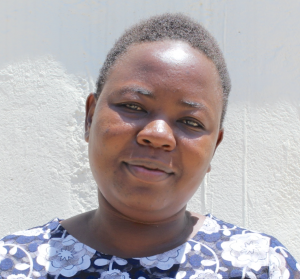
"Access to water is the foundation that makes dreams possible! For instance, access to clean water will help my children stay healthy and spend more time in school instead of being sick. With good health and more time to learn, they will have a better chance to achieve their dreams in the future and become leaders and professionals who will bring development back to this community," exclaimed Pamela Khakasa, a 37-year-old mother and farmer.

Ms. Pamela Khakasa.
She continued to explain the benefits of clean water for her family. "Having clean water will reduce sickness in the family, so we are not spending money on hospital bills. We can use that money for other household needs and to invest in small projects that will give us income. It also helps us save more time to work on other income-generating activities, like farming and casual labor, which means more money for my household."
Ten-year-old Lavelyne was just as excited about access to clean water as Pamela!

"Reliable water will help me learn better now, and that will help me achieve my dream in the future. When I am healthy and have enough time to study, I can do well in exams and become what I want to be when I grow up," Lavelyne shared.
Preparing for Spring Protection
Community members worked together to source all locally available construction materials for the spring. These included bricks, sand, stones, and fencing poles. Because people have to carry most items by hand, the material-collection process can take anywhere from a few weeks to months.

When the community was ready, we delivered the remaining construction materials, including cement, plastic tarps, and hardware. Then our construction artisan and field officers deployed to the spring to begin work.
Protecting the Spring: A Step-by-Step Process
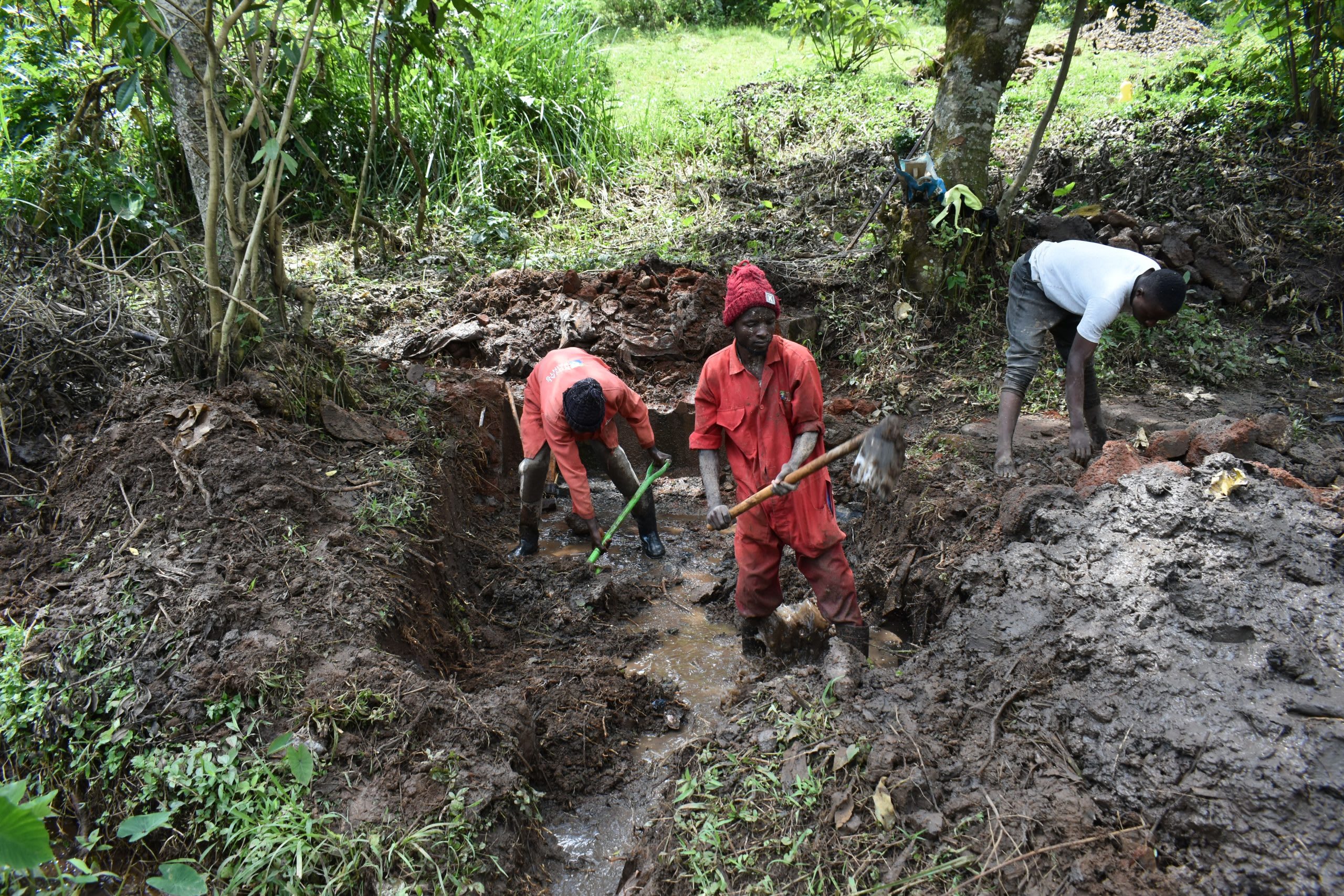
First, we excavated the spring area. This includes digging a drainage channel below the spring and several runoff diversion channels above and around the spring to help divert surface contaminants away.
To ensure community members could still access water throughout the construction process, we also dug temporary channels around the construction site to allow water to continue to flow. Excavation created space for setting the spring's foundation.

After establishing the base, made of thick plastic, wire, concrete, and waterproof cement, we started brickwork to build the spring walls and stairs. Once the walls were tall enough, we began one of the most crucial steps: setting the discharge pipe. The discharge pipe needs to be positioned low enough so the water level never rises above the spring's eye, yet high enough to allow room for the average collection container (20-liters) to sit beneath the pipe without making contact, to prevent cross-contamination.
If we place the pipe too high, back pressure could force water to emerge elsewhere. Too low, and community members would not be able to access the water easily.

In coordination with the walls and stairs, we cemented stones on both sides of the spring's drainage channel. These stones discourage people and animals from standing in that area, which could cause soil erosion and a clogged drainage area.
We then cemented and plastered the spring walls. These finishing layers reinforce the brickwork and prevent water in the reservoir from seeping through. In turn, enough pressure builds to push water out through the discharge pipe.
As the walls cured, we finished the stairs and installed tiles beneath the discharge pipe. The tiles protect the concrete from the falling water's erosive force.

We redirected the temporary diversion channels back into the reservoir box and closed all other exits to force water through only the discharge pipe. We filled the reservoir area with the large, clean stones, arranging them in layers like a well-fitting puzzle. We covered the rocks with thick plastic and piled enough dirt on top to compensate for future settling.

Community members transplanted grass to help prevent erosion, and the collection area was fenced. The fence prevents people or animals from walking in the area above the spring, as compaction of this area can potentially compromise water quality.

The construction process took about two weeks of work and patience. As soon as the spring was ready, people received permission from their local field officers to fetch water.

We officially transferred ownership of the waterpoint to the Inaya Community.
Happiness and thanksgiving flowed in all directions!
Training on Health, Hygiene, and More
Together with the community, we determined their preferred training date. When the day arrived, facilitators Stella Inganji and Joel Otuya deployed to the site to lead the event. 16 people attended the training, including 11 women and five men.
We discussed personal, oral, and environmental hygiene, emphasizing proper water handling, soap-making, and the ten steps of handwashing. We also highlighted the importance of primary health care and covered the operation and maintenance of the water point, as well as leadership and governance. By the end of the training, each participant had a clear understanding of their role in maintaining clean water and promoting good health within their community.

We held an election for the newly formed water user committee, which will oversee the maintenance of the spring. We brainstormed income-generating activities and encouraged them to start a group savings account for future minor repairs to the spring.

Onsite maintenance session.
"The conversation on site maintenance of the spring drew strong engagement. Participants wanted to know who would be responsible for cleaning the spring area and repairing damages. The conversation became very lively as participants compared the old struggle and [the] causes of their old water point getting damaged. The facilitator then explained the roles and responsibilities of every stakeholder. A memorable discussion came when community members suggested forming a water committee so that it would be responsible for planning and overseeing the water facility operations and maintenance. This showed a real sense of ownership and commitment to keeping the spring sustainable, especially because it was their own suggestion," shared trainer Stella Inganji.

Stella continued: "There were humorous moments during the oral hygiene discussion that made the session lively and engaging. One participant admitted that he first started brushing his teeth only because he saw people doing it on television, and at the time, he did not know the real reason behind it. Another joked that as a child, he brushed only when visitors were around because it seemed like something ‘modern’ people did. These stories made everyone laugh, but they also opened up an important conversation on the real benefits of brushing teeth, such as preventing toothaches and keeping gums healthy. The laughter helped participants feel comfortable, and from there they were able to share openly about their own practices and learn why regular oral hygiene is essential."

"The waste management topic was the most interesting because I discovered how much rubbish can affect our water and health. I learned new ways of disposing [of] waste properly and even reusing some items which I had never thought about before," said 40-year-old farmer and the newly elected chairperson of the water user committee, Frederick Angonje.

Mr. Frederick Angonje.
"The training has made me see hygiene as a community responsibility. I used to think it was just about my family, but now I know that if everyone keeps their homes and surroundings clean, the whole village will benefit. I will work with others to keep our spring site and environment clean. For me, the training was perfect. I would not change anything because it was clear, helpful, and easy to understand. I really enjoyed it," he concluded.
Thank you for making all of this possible!