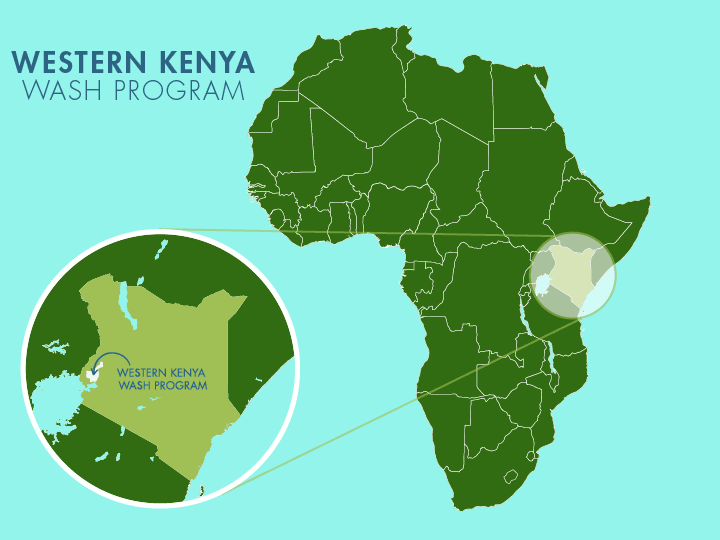
The Water Project’s WaSH program in Western Kenya aims to access, protect, filter, and purify the abundant waters that are available through two seasonal rains, prevalent springs, high water tables, and deep aquifers in the region. Explore water projects in communities, schools, and churches in Western Kenya such as protected springs, rainwater catchment systems, and water wells. This program emphasizes the power of strategic geographical saturation of projects, effective hygiene and sanitation training, and relational networking between NGOs, health workers, local politicians, and educators.
Springs are water sources that come from deep underground, where the water is filtered through natural layers until it is clean enough to drink. Once the water pushes through the surface of the Earth, however, outside elements like waste and runoff can contaminate the water quickly. We protect spring sources from contamination with a simple waterproof cement structure surrounding layers of clay, stone, and soil. This construction channels the spring’s water through a discharge pipe, making water collection easier, faster, and cleaner. Each spring protection also includes a chlorine dispenser at the waterpoint so community members can be assured that the water they are drinking is entirely safe.
Learn more about how spring protection works here!
Rehabilitation Project
Rehabilitation is not just fixing a pump - it’s total community re-engagement.
There’s only one thing we can think of that might be worse than not having safe water: having safe water, and then losing it because a project fell into disrepair.
Rehabilitation often proves to be a big challenge, as many wells have sit idle for years and there is typically little information about the specifics of the well. A borehole and dug well rehabilitation involves quite a bit of discovery. First, our teams work to discover as much as they can about the initial project. What materials were used? Was the borehole/protected dug well properly constructed? Many of these questions can only be answered by diving in, and doing “the work” which makes up a rehabilitation.
Once our teams have found the problem, they find the solution. Then, they reconstruct the well and install a hand pump.
Engagement and training with communities takes into account rehabilitation was needed and alters the program to suit the needs of the community. After all - engaging with this community in the same way which led to the initial, failed project will not bring new results. Our teams work to understand the social and support reasons leading to initial failure, and make those areas a focus of our ongoing engagement with communities.
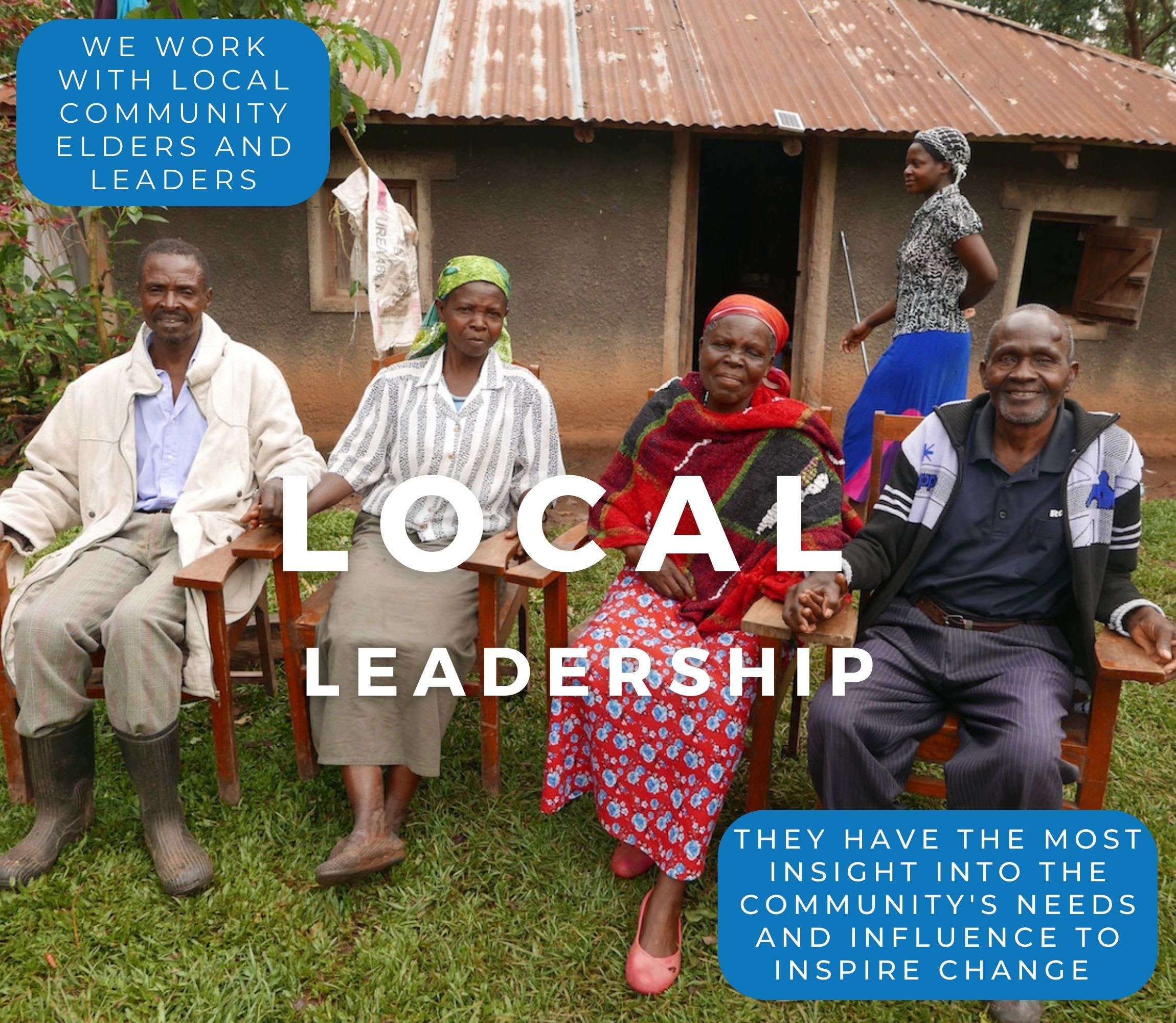
Local Leadership
Water projects last because of local leaders. They help us understand the realities on the ground and carry our shared goals to their neighbors. The Water Project identifies and partners with local organizations that share our commitment to water that is reliable, verifiable, and clean. Together we build solutions that belong to the community and keep watch over them for years to come. Your partnership makes that lasting, local work possible.
Community Engagement
The communities we serve are partners in the project, not recipients of it. Long before a single pipe is laid, we sit down with community members to build relationships, plan the project together, agree on how the water point will be managed, and prepare for the ongoing costs of keeping it running. The people who will use the water hold a leading seat at the table. Every project takes real collaboration among many stakeholders, and at each step we hold to the values your partnership makes possible: reliability, relationship, and trust.
Sanitation Platform (SanPlat)
Easily made latrine slabs encourage household bathroom construction.
Proper hygiene and sanitation facilities go hand-in-hand with access to clean, reliable water.
A SanPlat is most literally the slab one would squat over when utilizing the bathroom.
The community chooses 5 households to receive SanPlats made on site under our training and guidance. The goal: seeing the need for safe latrines throughout their community, each household will be inspired to build their own.
Hygiene and Sanitation Training
For many communities, water is only the beginning. When every drop has to be rationed, the things that keep people healthy, like bathing, cleaning, and handwashing, fall away, and where school was out of reach, the basics usually taught in health class were never learned. Water alone can't solve this, which is why your gift also funds hands-on training in every community, school, and health center we serve. We tailor each session to the region, but always cover the essentials: safe water handling and storage, personal and environmental hygiene, how disease spreads, how to form and run a water user committee, and how to operate and maintain the new water point. The goal is simple: to put people back in charge of their own health, so growth and development can begin.
Monitoring and Resolution
Across sub-Saharan Africa, too many wells fall into disrepair and are left behind. Reliability is the true measure of our work, so our commitment does not end when a project is finished. Water can only improve a life if it is there every time, and it can take only one sip of unsafe water to undo months of good health. That is why we measure downtime in hours, not days or weeks, and why every hour a water point is down matters. We monitor every project we have completed to keep the water running. Many donors sustain this work through The Water Promise, a community of monthly partners who keep water flowing long after installation day.
We’re working hard to make sure your gifts result in a lasting water project for the community it serves. Our engagement with a community begins many months before construction and lasts years after construction. The timeline here is focused on the physical construction of the water project. There is also training and engagement work that has already started.
Water project construction in the developing world is hard work. A lot of things can and do cause delays - which are normal. We attempt to make our best judgment of when construction will be complete, but the circumstances surrounding actual "in the field" conditions are far from our control.
Weather, supply availability, government paperwork, and progress of community involvement are just a few of the variables that can delay (and sometimes speed up) a project's completion.
We will always tell you if anything changes. And, if you get a notice like this – it’s actually further proof your gifts are being carefully used towards a water project that lasts.
Click icons to learn about each feature.
Report Submitted by Jacklyne Chelagat, Impact Communication Officer
Jacklyne loves seeing lives transformed by clean water. She is currently pursuing her degree in development studies and looks forward to how that will add even more value to her relationships with communities.
Jacklyne has been a Impact Communication Officer since 2014, with WeWaSaFo, The Water Project's trusted partner in our Western Kenya WaSH Program.
A normal day in Shilakaya begins early. Men get up to milk the cows and go straight to their sugarcane plantations. Women go to the spring to fetch water, get their children ready and off to school, and then does some cleaning chores. They then join the men who are already out working.
Water
Shanamwevo Spring produces a ton of water and draws hundreds to rely on it. Community members have fixed banana fiber to where they found water emerging, making it easy to fill their containers. However, the yield is so huge that they have to wade through tons of water to fill those containers. Since this spring is unprotected, it is subjected to many different contaminants. Nonetheless, the water is used for drinking, cooking, cleaning, and irrigating when it doesn't rain.
Poverty here is so high that there's no water storage back home; most families have to keep the water they fetched in the same small container.
After drinking water from Shanamwevo Spring, community members contract waterborne diseases like typhoid. Children are especially susceptible and miss class for days at a time.
Sanitation
A little more than half of the families living around Shanamwevo Spring have a pit latrine. Those who do have not maintained them; they are falling apart and pose huge danger to the users. And since there isn't full latrine coverage, open defecation is an issue.
Many households have helpful tools like dish racks and clotheslines, but we need to continue to engage on hand-washing stations. Washing hands regularly and having a safe place to do so is one of the most efficient ways to stop the spread of germs.
Trash disposal is particularly poor, with no one really knowing how important it is to dig a pit for garbage.
Here’s what we plan to do about it:
Training
Community members will attend hygiene and sanitation training for at least two days. This training will ensure participants have the knowledge they need about healthy practices and their importance. The facilitator plans to use PHAST (Participatory Hygiene and Sanitation Transformation), CLTS (Community-Led Total Sanitation), ABCD (Asset-Based Community Development), group discussions, handouts, and demonstrations at the spring. One of the most important topics we plan to cover is the handling, storage, and treatment of water. Having a clean water source will be extremely helpful, but it is useless if water gets contaminated by the time it’s consumed. Hand-washing will also be a big topic.
Training will also result in the formation of a committee that will oversee operations and maintenance at the spring. They will enforce proper behavior around the spring and delegate tasks that will help preserve the site, such as building a fence and digging proper drainage. The fence will keep out destructive animals, and the drainage will keep the area’s mosquito population at a minimum.
Sanitation Platforms
On the final day of training, participants will select five families that should benefit from new latrine floors.
Training will also inform the community and selected families on what they need to contribute to make this project a success. They must mobilize locally available materials, such as bricks, clean sand, hardcore, and ballast. The five families chosen for sanitation platforms must prepare by sinking a pit for the sanitation platforms to be placed over. All community members must work together to make sure that accommodations and food are always provided for the work teams.
Spring Protection
Protecting the spring will ensure that the water is safe, adequate and secure. Construction will keep surface runoff and other contaminants out of the water. With the community’s high involvement in the process, there should be a good sense of responsibility and ownership for the new clean water source.
Fetching water is predominantly a female role, done by both women and young girls. Protecting the spring and offering training and support will therefore help empower the female members of the community by giving them more time and efforts to engage and invest in income-generating activities.
This project is a part of our shared program with Western Water And Sanitation Forum (WEWASAFO). Our team is pleased to provide the reports for this project (formatted and edited for readability) thanks to the hard work of our friends in Kenya.
Project Updates
November, 2020: Through Their Eyes: COVID-19 Chronicles with Margaret Alubwa
This post is part of a new series by The Water Project meant to highlight the perspectives and experiences of the people we serve and how the COVID-19 pandemic is impacting them. We invite you to read more of their stories here.
Our team recently visited Shilakaya to conduct a COVID-19 prevention training (read more about it below!) and monitor their water point, Shanamwevo Spring. Shortly after, we returned to check in on the community, offer a COVID-19 refresher training, and ask how the pandemic is affecting their lives.
It was during this most recent visit that Margaret Alubwa shared her story of how the coronavirus is impacting her life and her community. Margaret is a 63-year-old who works as a teacher in the community. She also serves as Secretary of the spring's water user committee.
Margaret Alubwa outside her home
Field Officer Jacklyne Chelagat met Margaret outside her home to conduct the interview. Both Jacklyne and Margaret observed physical distancing and other precautions throughout the visit to ensure their health and safety. The following is Margaret's story, in her own words.
What is one thing that has changed in your community since the completion of the water project?
"Community members are accessing clean and safe water. They are healthy and energetic enough to engage in different development activities to generate income."
How has having a clean water point helped you through the pandemic so far?
"The sufficient supply of clean and safe water was handy in handwashing and promoting high standards of hygiene and sanitation at home."
Margaret washing her hands at home with soap and clean water from the spring using a tippy tap handwashing station
Since the outbreak of COVID-19 in Kenya, has fetching water changed for you because of restrictions, new rules, or your concerns about the virus?
"Fetching water is no longer the usual thing. Community members have tried to follow the COVID-19 regulations and measures. We no longer congest at the spring site, social distance is observed, some wear masks, and the elderly no longer come to fetch water."
Margaret (seated) with the other leaders of the water user committee
How has COVID-19 impacted your family?
"The closure of schools was a challenge as most children could not settle and study."
What other challenges are you experiencing due to the COVID-19 pandemic?
"Poverty levels have increased to the highest levels. Some of my family breadwinners lost their jobs, making life difficult for both of us. No freedom of movement hindered us from exploring more and searching for greener pastures for us."
Margaret with the water user committee Chair (left) and her son (right)
What hygiene and sanitation steps have you and your community taken to stop the spread of the virus?
"Community members are ensuring they have proper handwashing facilities - tippy taps or leaky tins - they wash their hands frequently, and also they wear masks in gatherings and when coming to the spring."
Margaret hangs clothes to dry
Like most governments around the world, the Kenyan government continues to set and adjust restrictions both nationally and regionally to help control the spread of the virus.
What restriction were you most excited to see lifted already?
"I was excited to go back to church and also see our finalist students going back to finish their academic year."
Margaret with her mask on
When asked where she receives information about COVID-19, Margaret listed the radio, television, and our team's sensitization training.
What has been the most valuable part of the COVID-19 sensitization training you received from our team?
"Demonstrations on the proper way of mask making, making the tippy taps, and the proper way to wash hands. Holistically, am impressed with the entire acquired information on COVID-19."
June, 2020: COVID-19 Prevention Training Update at Shilakaya Community, Shanamwevo Spring
We are carrying out awareness and prevention trainings on the virus in every community we serve. Very often, our teams are the first (and only) to bring news and information of the virus to rural communities like Shilakaya, Kenya.
We trained more than 19 people on the symptoms, transmission routes, and prevention of COVID-19. Due to public gathering concerns, we worked with trusted community leaders to gather a select group of community members who would then relay the information learned to the rest of their family and friends.
Constructing a tippy tap station
We covered essential hygiene lessons:
- Demonstrations on how to build a simple handwashing station
- Proper handwashing technique
- The importance of using soap and clean water for handwashing
- Cleaning and disinfecting commonly touched surfaces including at the water point.
Handwashing demonstration
We covered COVID-19-specific guidance in line with national and international standards:
- Information on the symptoms and transmission routes of COVID-19
- What social distancing is and how to practice it
- How to cough into an elbow
- Alternative ways to greet people without handshakes, fist bumps, etc.
- How to make and properly wear a facemask.
Handwashing
During training, we installed a new handwashing station with soap near the community’s water point, along with a sign with reminders of what we covered.
Due to the rampant spread of misinformation about COVID-19, we also dedicated time to a question and answer session to help debunk rumors about the disease and provide extra information where needed.
Homemade mask tutorial
We continue to stay in touch with this community as the pandemic progresses. We want to ensure their water point remains functional and their community stays informed about the virus.
July, 2019: Giving Update: Shilakaya Community, Shanamwevo Spring
A year ago, your generous donation enabled us to protect Shanamwevo Spring for Shilakya Community in Keya. The contributions of incredible monthly donors and others giving directly to The Water Promise allow our local teams to visit project sites throughout the year, strengthening relationships with communities and evaluating the water project over time. These consistent visits allow us to learn vital lessons and hear amazing stories. Read more…
May, 2018: Shilakaya Community Project Complete
Shilakaya Community now has clean water! Shanamwevo Spring has been transformed into a flowing source of clean water thanks to your donation. The spring is protected from contamination, five sanitation platforms have been provided for the community, and training has been done on sanitation and hygiene.
New Knowledge
This hygiene and sanitation training was unique. As the field officer made routine visits to the spring, they realized there were dozens of community members coming and going to witness the construction. The field officer spent a chunk of the time at the spring, inviting people to come back the following day to learn important information about their health.
This was an amazing training forum, with so many children who came, even without their parents. They sat quietly and listened keenly to all the information shared. Their bright faces showed not only great understanding but satisfaction with what they were learning.
There was a huge turnout!
The field officer clearly communicated the areas of needed improvement for Shihingo, which included the following topics and more:
– Handwashing and personal hygiene
– Handling water and food hygienically
– Safe waste disposal
– Water treatment
Lessons on handwashing
Since we were right at the spring, the artisan was able to take a break from his work to introduce the protection concept and why it's effective. He listed some ways community members could help him finish work over the next few days, too. He also told them to best maintain the spring, they should build a fence and dig drainage.
"Initially if someone would ask me whether I washed my hands properly, I would have said yes. But today I am greatly shocked by the amount of germs I have been consuming due to not having the information on how to wash my hands properly," Village Elder Roselyne said.
"All of us have gained more important information that we weren't aware of. Thank you!".
Sanitation Platforms
All five sanitation platforms have been installed. These five families are happy about this milestone of having a private latrine of their own and are optimistic that people will no longer leave waste outdoors. We are continuing to encourage families to finish building walls and roofs over their new latrine floors.
Spring Protection
Community members provided all locally available construction materials, e.g bricks, wheelbarrows of clean sand, wheelbarrows of ballast, fencing poles and gravel. Accommodations and meals were provided for the artisan, too. Men and women lent their strength to the artisan to help him with manual labor.
Everything went smoothly to transform Shanamwevo Spring into a clean water source. The artisan found a crab living there, which was an exciting moment since it was the first crab sighting for several community members.
What is that thing?
The only challenge was finding enough hardcore to fill the area behind the discharge pipe. It took longer than normal, but the community brought in what the artisans needed, thanks to the encouragement of Village Elder Roselyne, otherwise known as "Liguru."
All of the space behind that pipe had to be filled with hardcore, otherwise known as... rocks.
Field Officer Jacklyne Chelagat commented on her experience working with this community, saying "I must admit that I was humbled by the initiative Liguru undertook to ensure that the hardcore was enough. She literally took a whistle and went around the village blowing the whistle to mobilize people. With her assistance and able leadership, we managed to raise the hardcore we needed."
"From this experience, I learned that women are important people in the community and cannot be overlooked. When a woman is in leadership, the community is safe since she understands the challenges women go through and she can do anything to remedy the situation."
Liguru, leading the celebration!
Several people joined the Liguru to celebrate the completion of this spring protection project. They didn't only bring their smiles, but they brought their empty containers to fill at one of the four pipes currently flowing with clean water.
February, 2018: Shilakaya Community Project Underway
Shilakaya Community will soon have a clean, safe source of water thanks to your donation! Community members have been drinking contaminated water from Shanamwevo Spring, and contend with the consequences on a daily basis. Our partner conducted a survey of the area and deemed it necessary to protect the spring, build new sanitation platforms (safe, easy-to-clean concrete floors for latrines), and conduct sanitation and hygiene training.
Thanks to your generosity, waterborne disease will no longer be a challenge for the families here. Please take some time to get to know your community through the narrative and pictures posted to this page. We look forward to reaching out again with good news!
Project Videos
Project Photos
Project Type
Springs are water sources that come from deep underground, where the water is filtered through natural layers until it is clean enough to drink. Once the water pushes through the surface of the Earth, however, outside elements like waste and runoff can contaminate the water quickly. We protect spring sources from contamination with a simple waterproof cement structure surrounding layers of clay, stone, and soil. This construction channels the spring’s water through a discharge pipe, making water collection easier, faster, and cleaner. Each spring protection also includes a chlorine dispenser at the waterpoint so community members can be assured that the water they are drinking is entirely safe.
Learn more about how spring protection works here!
Giving Update: Shilakaya Community, Shanamwevo Spring
July, 2019
A year ago, you funded a spring protection at Shilakaya Community in Kenya – creating a life-changing moment for Befry Mwanje. Thank you!
Keeping The Water Promise
There's an incredible community of monthly donors who have come alongside you in supporting clean water in Shilakaya Community, Shanamwevo Spring.
This giving community supports ongoing sustainability programs that help Shilakaya Community, Shanamwevo Spring maintain access to safe, reliable water. Together, they keep The Water Promise.
We’re confident you'll love joining this world-changing group committed to sustainability!
Implementation of the WaSH projects at Shilakaya Village has brought tremendous positive results in this community. On our most recent visit here, just like all of our previous visits, the warm welcome we received from this community is a clear indication of the satisfaction received from the project. The great energy and vigor individuals possess is in part a result of the good health each person is enjoying. The WaSH projects have united community members and for that reason, each person is now development-conscious. They have remained focused and determined to maintain Shanamwevo Spring well.
John Shilaho, the Chair of the Shanamwevo water user committee, was more than happy to sit down with us and share how the protected spring has changed his life and the lives around him.
"The WaSH project has brought with it very many positive results in our community," Mr. Shilaho said.
Field Officer Jacklyne and Mr. John Shilaho, Chair of the Shanamwevo Spring water user committee
"The community has transformed in various ways. [For example,] the conflicts earlier experienced among neighbors due to minor disagreements...[are] now a thing of the past and we all live in unity. The financial resources that were initially used for medicinal purposes are now spent catering to development activities since people rarely go to hospitals for treatment of water- [and] sanitation-related diseases...You are a Godsend and [we] love you all."
John sits to be interviewed
12-year-old Befry Mwanje joined us at the spring during our visit. Befry was glowing as she shared her story with us.
"[I] am such a happy and very excited child, [I] am so fortunate to have been born in this community," Befry began.
Befry (right) with Field Officer Jacklyne
"Initially, accessing water was a problem and many times I was scared of being sent to fetch water. Protection of our spring has boosted my morale and I find [it] fun going to fetch water."
Befry, Jacklyne, and John
"Most of my problems are in the past; clean and safe water [from an] easily accessible water source, reduction in diseases, good health, attending class lessons daily, and excellent academic performance is [now] my [share in life]...I no longer [have] diarrhea or...complain of stomachache, courtesy of you. God bless."
Fetching water
Shilakaya is a united community full of love and care for one another. A little over a year since its completion, Shanamwevo Spring is still intact and in good working condition. With 4 gushing discharge pipes, it continues to serve a huge population throughout all the seasons, even in drought.
The aesthetic value of the community has also significantly improved, as deep mud trenches are a thing of the past compared to the neat, safely accessible spring.
Look at that discharge!
Navigating through intense dry spells, performing preventative maintenance, conducting quality repairs when needed and continuing to assist community leaders to manage water points are all normal parts of keeping projects sustainable. The Water Promise community supports ongoing sustainability programs that help Shilakaya Community, Shanamwevo Spring maintain access to safe, reliable water.
We’d love for you to join this world-changing group committed to sustainability.
The most impactful way to continue your support of Shilakaya Community, Shanamwevo Spring – and hundreds of other places just like this – is by joining our community of monthly givers.
Your monthly giving will help provide clean water, every month... keeping The Water Promise.
Contributors
Data Abstract Solutions, Inc. Rock Creek Presbyterian Church
 Protected Spring

 Rehabilitation Project