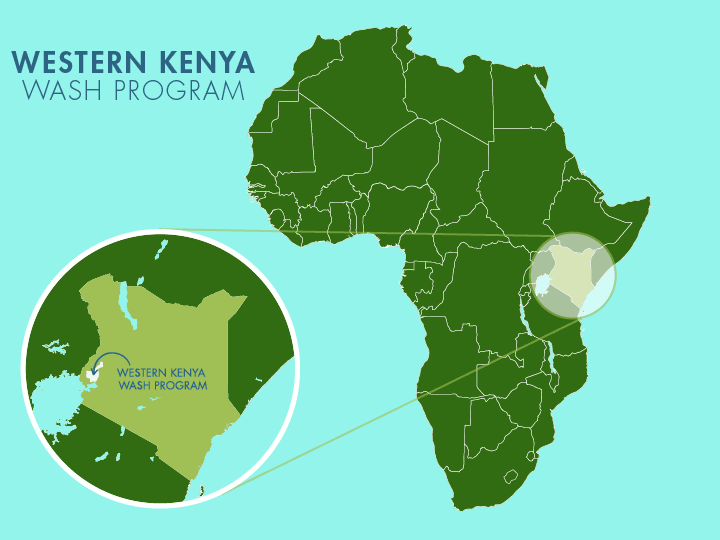
The Water Project’s WaSH program in Western Kenya aims to access, protect, filter, and purify the abundant waters that are available through two seasonal rains, prevalent springs, high water tables, and deep aquifers in the region. Explore water projects in communities, schools, and churches in Western Kenya such as protected springs, rainwater catchment systems, and water wells. This program emphasizes the power of strategic geographical saturation of projects, effective hygiene and sanitation training, and relational networking between NGOs, health workers, local politicians, and educators.
Springs are water sources that come from deep underground, where the water is filtered through natural layers until it is clean enough to drink. Once the water pushes through the surface of the Earth, however, outside elements like waste and runoff can contaminate the water quickly. We protect spring sources from contamination with a simple waterproof cement structure surrounding layers of clay, stone, and soil. This construction channels the spring’s water through a discharge pipe, making water collection easier, faster, and cleaner. Each spring protection also includes a chlorine dispenser at the waterpoint so community members can be assured that the water they are drinking is entirely safe.
Learn more about how spring protection works here!
Rehabilitation Project
Rehabilitation is not just fixing a pump - it’s total community re-engagement.
There’s only one thing we can think of that might be worse than not having safe water: having safe water, and then losing it because a project fell into disrepair.
Rehabilitation often proves to be a big challenge, as many wells have sit idle for years and there is typically little information about the specifics of the well. A borehole and dug well rehabilitation involves quite a bit of discovery. First, our teams work to discover as much as they can about the initial project. What materials were used? Was the borehole/protected dug well properly constructed? Many of these questions can only be answered by diving in, and doing “the work” which makes up a rehabilitation.
Once our teams have found the problem, they find the solution. Then, they reconstruct the well and install a hand pump.
Engagement and training with communities takes into account rehabilitation was needed and alters the program to suit the needs of the community. After all - engaging with this community in the same way which led to the initial, failed project will not bring new results. Our teams work to understand the social and support reasons leading to initial failure, and make those areas a focus of our ongoing engagement with communities.
Local Leadership
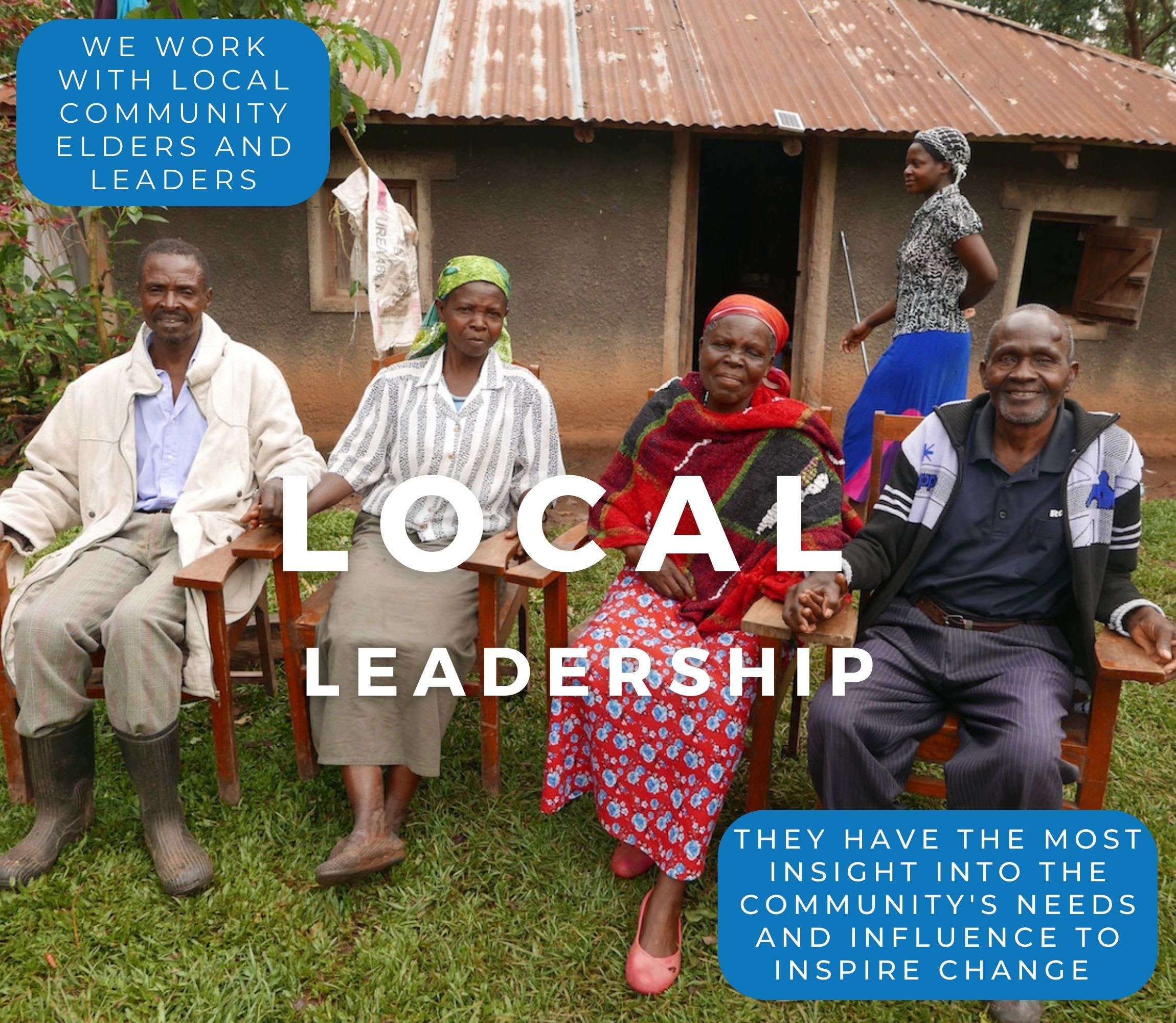
Water projects last because of local leaders. They help us understand the realities on the ground and carry our shared goals to their neighbors. The Water Project identifies and partners with local organizations that share our commitment to water that is reliable, verifiable, and clean. Together we build solutions that belong to the community and keep watch over them for years to come. Your partnership makes that lasting, local work possible.
Community Engagement
The communities we serve are partners in the project, not recipients of it. Long before a single pipe is laid, we sit down with community members to build relationships, plan the project together, agree on how the water point will be managed, and prepare for the ongoing costs of keeping it running. The people who will use the water hold a leading seat at the table. Every project takes real collaboration among many stakeholders, and at each step we hold to the values your partnership makes possible: reliability, relationship, and trust.
Chlorine Dispenser
At every spring protection project, we install a specially engineered chlorine dispenser right at the water point, so families can treat their water with a pre-measured, safe dose in seconds. Diluted chlorine is a trusted part of water treatment worldwide, and it keeps working for two to three days, so water stays safe even after it is carried home and stored. We provide the chlorine and maintain the dispensers as part of our ongoing support, so your partnership keeps protecting health well beyond installation day.
Hygiene and Sanitation Training
For many communities, water is only the beginning. When every drop has to be rationed, the things that keep people healthy, like bathing, cleaning, and handwashing, fall away, and where school was out of reach, the basics usually taught in health class were never learned. Water alone can't solve this, which is why your gift also funds hands-on training in every community, school, and health center we serve. We tailor each session to the region, but always cover the essentials: safe water handling and storage, personal and environmental hygiene, how disease spreads, how to form and run a water user committee, and how to operate and maintain the new water point. The goal is simple: to put people back in charge of their own health, so growth and development can begin.
Monitoring and Resolution
Across sub-Saharan Africa, too many wells fall into disrepair and are left behind. Reliability is the true measure of our work, so our commitment does not end when a project is finished. Water can only improve a life if it is there every time, and it can take only one sip of unsafe water to undo months of good health. That is why we measure downtime in hours, not days or weeks, and why every hour a water point is down matters. We monitor every project we have completed to keep the water running. Many donors sustain this work through The Water Promise, a community of monthly partners who keep water flowing long after installation day.
We’re working hard to make sure your gifts result in a lasting water project for the community it serves. Our engagement with a community begins many months before construction and lasts years after construction. The timeline here is focused on the physical construction of the water project. There is also training and engagement work that has already started.
Water project construction in the developing world is hard work. A lot of things can and do cause delays - which are normal. We attempt to make our best judgment of when construction will be complete, but the circumstances surrounding actual "in the field" conditions are far from our control.
Weather, supply availability, government paperwork, and progress of community involvement are just a few of the variables that can delay (and sometimes speed up) a project's completion.
We will always tell you if anything changes. And, if you get a notice like this – it’s actually further proof your gifts are being carefully used towards a water project that lasts.
Click icons to learn about each feature.
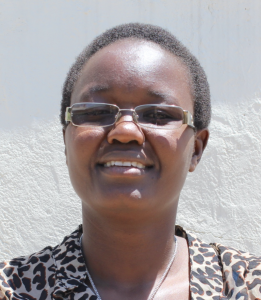
Report Submitted by Olivia Bomji, Training Officer
Olivia started her work to bring clean water and health knowledge to communities in 2016. Starting as just an intern, she fell in love with the work and signed a contract to be full time in 2018. She has a passion to come alongside community members to help them better their lives.
Olivia recently finished an online degree in social work and community development.
Olivia has been a Training Officer since 2018, with WeWaSaFo, The Water Project's trusted partner in our Western Kenya WaSH Program.
The 350 community members that use Shangura Spring get up very early in hopes of fetching water before the spring gets stirred up from other users jerrycans and scooping jugs. But before they can collect water they must clean it each time they visit since children often play in the spring and leave chewed sugarcane in the water.
But these efforts, sadly, are a waste of time: no matter how tidy the area around the spring is, and no matter how early people get there, the water will still carry disease.
"I have had diarrhea so many times and [been] hospitalized at the same time," said 13-year-old Celestine O. (pictured below at the spring). "I missed school for two weeks because I was at the hospital."
This problem is not new, according to Ayub Mwaka, a 73-year-old farmer (seen in the below picture). "I have used this water source for more than 40 years. Currently, the water is dirty. Sometimes, when [I] am thirsty, when I see the water and imagine the source, the thirst goes away."
But the prospect of protecting the spring has given Ayub and Celestine hope. "Now that my grandchildren are suffering because of waterborne diseases, it will be my joy that they access clean and safe water in [the] future," said Ayub.
Celestine added: "My prayer is that the spring will be protected and clean, safe water will be flowing, meaning no more sickness but a healthy life."
What We Can Do:
Spring Protection
Protecting the spring will help provide access to cleaner and safer water and reduce the time people have to spend to fetch it. Construction will keep surface runoff and other contaminants out of the water. With the community’s high involvement in the process, there should be a good sense of responsibility and ownership for the new clean water source.
Fetching water is a task predominantly carried out by women and young girls. Protecting the spring and offering training and support will, therefore, help empower the female members of the community by freeing up more of their time and energy to engage and invest in income-generating activities and their education.
Training on Health, Hygiene, COVID-19, and More
To hold trainings during the pandemic, we work closely with both community leaders and the local government to approve small groups to attend training. We ask community leaders to invite a select yet representative group of people to attend training who will then act as ambassadors to the rest of the community to share what they learn. We also communicate our expectations of physical distancing and wearing masks for all who choose to attend.
The training will focus on improved hygiene, health, and sanitation habits in this community. We will also have a dedicated session on COVID-19 symptoms, transmission routes, and prevention best practices.
With the community’s input, we will identify key leverage points where they can alter their practices at the personal, household, and community levels to affect change. This training will help to ensure participants have the knowledge they need about healthy practices and their importance to make the most of their water point as soon as water is flowing.
Our team of facilitators will use a variety of methods to train community members. Some of these methods include participatory hygiene and sanitation transformation, asset-based community development, group discussions, handouts, and demonstrations at the spring.
One of the most important issues we plan to cover is the handling, storage, and treatment of water. Having a clean water source will be extremely helpful, but it is useless if water gets contaminated by the time it is consumed. We and the community strongly believe that all of these components will work together to improve living standards here, which will help to unlock the potential for these community members to live better, healthier lives.
We will then conduct a small series of follow-up trainings before transitioning to our regularly scheduled support visits throughout the year.
Training will result in the formation of a water user committee, elected by their peers, that will oversee the operations and maintenance of the spring. The committee will enforce proper behavior around the spring and delegate tasks that will help preserve the site, such as building a fence and digging proper drainage channels. The fence will keep out destructive animals and unwanted waste, and the drainage will keep the area’s mosquito population at a minimum.
Project Updates
August, 2022: Shanguya Spring Protection Complete!
Suge Community now has access to clean water! We transformed Shanguya Spring into a flowing source of naturally filtered water thanks to your donation. Our team also trained the community on improved sanitation and hygiene practices. Together, these components will unlock the opportunity for community members to live better, healthier lives.
"Water is life. It has been a long journey of suffering due to [a] lack of clean water. [The] protection of Shanguya Spring will play a vital role in boosting my health, thus increasing my life span," said 52-year-old farmer and chairperson of the water user committee Imelda Mutola.
{Imelda thanks the St. Therese Foundation for their generous support of this project in the video below.}
"Protection of this spring has germinated great ideas of reducing [our] poverty levels. I will actively embrace soap-making as a major income-generating activity," concluded Imelda.
Children were just as excited as adults about the new waterpoint.
"The access to clean and safe water will automatically improve on my health standards. I will be energetic enough to help my parents with house chores and also attend class lessons daily," commented 12-year-old James R.
James getting a drink from the spring.
"[The] protection of my spring will [also] allow me [to] save more time, [and] this will give me enough chance to study and perform better in my academics," concluded James.
Preparing for Spring Protection
Community members worked together to source and carry all locally available construction materials to the spring. These included bricks, sand, stones, and fencing poles. Some people also chiseled away at large rocks to break them down into gravel. Because people have to carry most items by hand, the material-collection process can take anywhere from a few weeks to months.
When the community was ready, we sent a lorry to deliver the remaining construction materials, including cement, plastic tarps, and hardware. Then, our construction artisan and field officers deployed to the spring to begin work. Individual households provided meals throughout each day to sustain the work team.
From Open Source to Protected Spring: A Step-by-Step Process
First, we cleared and excavated the spring area. Next, we dug a drainage channel below the spring and several runoff diversion channels above and around the spring. These help to divert surface contaminants away.
To ensure community members could still access water throughout the construction process, we also dug temporary channels from the spring's eye around the construction site. This allowed water to flow without disrupting community members' tasks or the construction work. Excavation created space for setting the spring's foundation, made of thick plastic tarp, wire mesh, concrete, and waterproof cement.
After establishing the base, we started brickwork to build the headwall, wing walls, and stairs. Once the walls had grown tall enough, we began one of the most crucial steps: setting the discharge pipe. The discharge pipe needs to be positioned low enough in the headwall so the water level never rises above the spring's eye, yet high enough to allow room for the average jerrycan (a 20-liter container) to sit beneath the pipe without making contact.
If we place the discharge pipe too high above the spring's eye, backpressure could force water to emerge elsewhere. Too low, and community members would not be able to access the water easily. We embedded the pipe using clay (or mortar when clay is in short supply) and placed it at an incline to ensure water flows in the right direction.
In coordination with brickwork, we pitched stones on both sides of the spring's drainage channel. We then cemented and plastered each stone, forming the rub walls. These walls discourage people and animals from standing in that area, which could cause soil erosion and a clogged drainage area.
We then cemented and plastered both sides of the headwall and wing walls. These finishing layers reinforce the brickwork and prevent water in the reservoir from seeping through the walls. In turn, enough pressure builds in the reservoir box to push water out through the discharge pipe.
As the headwall and wing walls cured, we cemented and plastered the stairs and installed four tiles beneath the discharge pipe. The tiles protect the concrete from the falling water's erosive force while beautifying the spring and facilitating easy cleaning of the spring floor.
The final stage of construction is backfilling the reservoir box behind the discharge pipe. We cleared the collection box of any debris that may have fallen during construction. Then we redirected the temporary diversion channels back into the reservoir box, channeling water into this area for the first time. We closed off all of the other exits to start forcing water through the discharge pipe only.
We filled up the reservoir area with the large, clean stones community members had gathered, arranging them in layers like a well-fitting puzzle. We covered the rocks with a thick plastic tarp to minimize potential contamination sources, then piled enough dirt on top to compensate for future settling.
Community members transplanted grass onto the backfilled soil to help prevent erosion. Finally, the collection area was fenced to discourage any person or animal from walking on it. Compaction can lead to disturbances in the backfill layers and potentially compromise water quality.
The entire construction process took about two weeks of work and patience to allow the cement and plaster to finish curing. As soon as the spring was ready, people got the okay from their local field officers to fetch water.
Our field officer Jacklyne Chelagat said: "It was so exciting to see both Christians and Muslims coming together, pooling resources and joining hands for the sake of clean and safe water."
We officially handed over the spring to mark the community's ownership of the water point. Happiness, thanksgiving, and appreciation were the order of the day, flowing in all directions.
After the training was completed, community members gathered together with training facilitators and converged at the spring site. Women danced and ululated while carrying their jerricans to fetch clean water. The event was colorful and full of joy!
Training on Health, Hygiene, and More
Together with the community, we found their preferred date for training while considering other community calendar events, such as the agricultural season and social events. We requested a representative group of community members to attend training and relay the information learned to the rest of their family and friends.
When the day arrived, facilitators Jacklyne Chelagat and Victor Musemi deployed to the site to lead the event. 25 people attended the training, including 23 women and two men. We held the training in a field owned by the local mosque near the spring site.
Handwashing demo using a tippy tap.
We covered several topics, including community participation in the project, leadership and governance, personal and environmental hygiene, water handling and treatment, spring maintenance, dental hygiene, the ten steps of handwashing, disease prevention, and how to make and use handwashing stations.
Trainer Jacklyne shows the proper handwashing techniques.
During the leadership and governance session, we held an election for the newly formed water user committee leaders, who will oversee the maintenance of the spring. We also brainstormed income-generating activities. Community members can now start a group savings account for any future minor repairs to the spring and a cooperative lending group, enabling them to develop small businesses.
The soap-making session was a highlight of the day. Training participants were alert and each person paid careful attention so they could understand the process.
"This training has been an eye opener to great and good ideas. I have not only learned how to take very good care of the spring, but also learned new skills in soap making," said Ramadhan Shanguya, a 23-year-old farmer and secretary of the water user committee.
Ramadhan.
"The knowledge acquired will basically lead to an income-generating activity. Poverty is not my portion," he concluded.
Training participants.
Conclusion
This project required a substantial collaboration between our staff, our in-country teams, and the community members themselves. When an issue arises concerning the spring, the water user committee is equipped with the necessary skills to rectify the problem and ensure the water point works appropriately. However, if the issue is beyond their capabilities, they can contact their local field officers to assist them.
Also, we will continue to offer them unmatchable support as a part of our monitoring and maintenance program. We walk with each community, problem-solving together when they face challenges with functionality, seasonality, or water quality. Together, all these components help us strive for enduring access to reliable, clean, and safe water for this community.
With your contribution, one more piece has been added to a large puzzle of water projects. In our target areas, we're working toward complete coverage of reliable, maintained water sources within a 30-minute round trip for each community, household, school, and health center. With this in mind, search through our upcoming projects to see which community you can help next!
Thank you for making all of this possible!
June, 2022: Suge Community Spring Protection Underway!
A severe clean water shortage in Suge Community drains people’s time, energy, and health. Thanks to your generosity, we’re working to install a clean water point and much more.
Get to know this community through the introduction and pictures we’ve posted, and read about this water, sanitation, and hygiene project. We look forward to reaching out with more good news!
Project Photos
Project Type
Springs are water sources that come from deep underground, where the water is filtered through natural layers until it is clean enough to drink. Once the water pushes through the surface of the Earth, however, outside elements like waste and runoff can contaminate the water quickly. We protect spring sources from contamination with a simple waterproof cement structure surrounding layers of clay, stone, and soil. This construction channels the spring’s water through a discharge pipe, making water collection easier, faster, and cleaner. Each spring protection also includes a chlorine dispenser at the waterpoint so community members can be assured that the water they are drinking is entirely safe.
Learn more about how spring protection works here!
A Year Later: Improved Water, Improved Lives!
October, 2023
A year ago, your generous donation helped Suge Community in Kenya access clean water – creating a life-changing moment for James. Thank you!
Keeping The Water Promise
There's an incredible community of monthly donors who have come alongside you in supporting clean water in Suge Community.
This giving community supports ongoing sustainability programs that help Suge Community maintain access to safe, reliable water. Together, they keep The Water Promise.
We’re confident you'll love joining this world-changing group committed to sustainability!
James C, 11, recalled what life was like in Suge Community before his well was installed last year.
"Water was [so] dirty that sometimes we had to wait for it to clear before collecting. The environment also was muddy and slippery because the drainage was not well maintained," James shared.
But life is much easier for James and the other community members in Suge Community now.
"I used to skip school when I was not feeling well after drinking water from the spring, but now I attend school daily, which will help me have good grades."
Having ready access to water from the well has made a difference for James, allowing him to have the time and energy to attend school regularly. Not only will his life improve with safe water, but he will also have a brighter future with a good education.
Right now, there are others in neighboring communities that desperately need safe water access. Your support will immediately go to work to provide a clean water project - and we can't wait to introduce you to the next person you'll help.
Navigating through intense dry spells, performing preventative maintenance, conducting quality repairs when needed and continuing to assist community leaders to manage water points are all normal parts of keeping projects sustainable. The Water Promise community supports ongoing sustainability programs that help Suge Community maintain access to safe, reliable water.
We’d love for you to join this world-changing group committed to sustainability.
The most impactful way to continue your support of Suge Community – and hundreds of other places just like this – is by joining our community of monthly givers.
Your monthly giving will help provide clean water, every month... keeping The Water Promise.
 Protected Spring

 Rehabilitation Project