A year ago, your generous donation helped the Forikolo DEC Primary School in Sierra Leone access clean water – creating a life-changing moment for Isha. Thank you!
Last year, your gift unlocked the potential for a brighter future for Isha. Since then, she and the other 330 students and staff at Forikolo DEC Primary School have had clean, reliable water. Your contribution has made a significant impact. Thank you for making a difference!
"Fetching water here is simple and fast. This is because the waterpoint is within the school premises." - Isha.
Before the Well Rehabilitation
Like many in Sierra Leone, 13-year-old Isha was responsible for collecting water to meet her school's daily water needs. Before last year’s water intervention, this task stole her time, keeping her out of school and negatively affecting her education.
A student collecting water before the well rehabilitation.
Drinking the water caused severe consequences. Many in her community suffered from waterborne diseases that created health problems, affecting their daily lives. Limited accessibility also meant students wasted time collecting sufficient water to meet their needs. The difficult journey to collect water sapped their physical and emotional energy, creating roadblocks. For Isha, in particular, it lessened her opportunity to learn since she spent so much time outside school collecting water.
"I was unable to get safe, pure, and sufficient water before the completion of this project. Fetching water was difficult before the completion of this project. I used to go out of the school premises to fetch water and that was time-wasting," said Isha.
Since the Well Rehabilitation
Your generous gift last year was much more than a simple donation; it was a powerful statement about your commitment to this community and Isha’s future. By supporting the water solution, you made clean water an everyday reality, fostering hope for a brighter future.
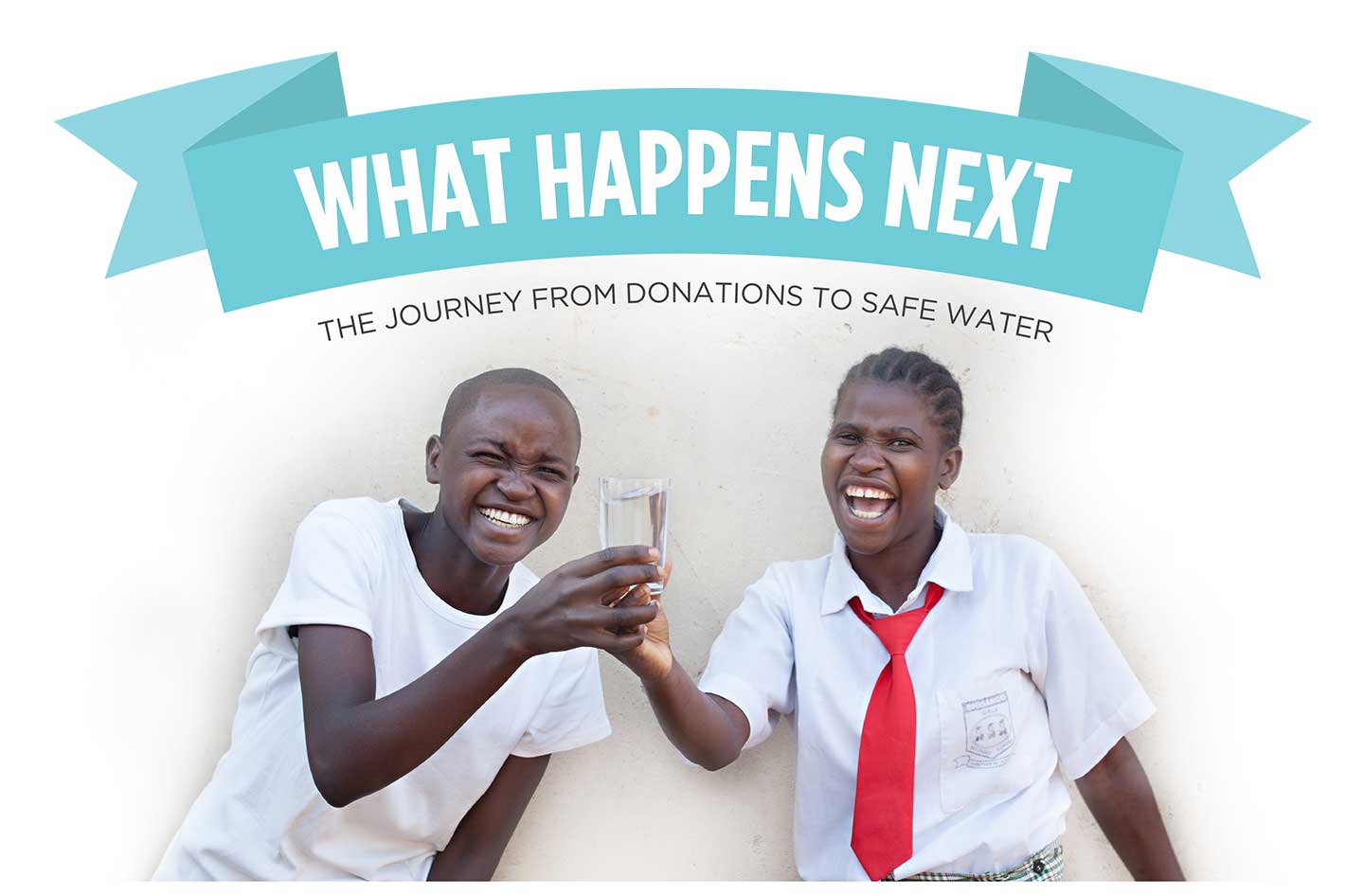
Isha admires clean water with her classmates.
Reliable and clean water lays the groundwork for improved health, education, and economic possibilities, allowing people to thrive. We frequently hear from those we interview that "water is life!"
"I had been doing well, since the installation of this well. Since the installation of this well, I haven't gone out of the school premises to fetch water," said Isha.
The Future is Looking Bright!
A year ago, you made a difference for Isha and the rest of her school. This is just the first chapter of their story as access to clean water continues to improve their lives!
At The Water Project, we value sustainability and want to ensure that people continue to thrive. We commit to monitoring this project to ensure the water is always flowing and safe to consume. We inspect the system hardware, track water availability, conduct sanitary inspections, and collect water quality samples to identify risks. We work with our team on the ground to resolve them.
You gave Isha a crucial tool for achieving her dreams: access to clean water. Together, we can excitedly expect that with this precious resource, her enthusiasm and courage will help fulfill dreams.
"The installation of this waterpoint has made me improve academically. I use more of my time in reading my notes, because fetching water does not take long like before. I am dreaming to be a medical practitioner," said Isha.
Navigating through intense dry spells, performing preventative maintenance, conducting quality repairs when needed and continuing to assist community leaders to manage water points are all normal parts of keeping projects sustainable. The Water Promise community supports ongoing sustainability programs that help Forikolo DEC Primary School maintain access to safe, reliable water.
We’d love for you to join this world-changing group committed to sustainability.
The most impactful way to continue your support of Forikolo DEC Primary School – and hundreds of other places just like this – is by joining our community of monthly givers.
Your monthly giving will help provide clean water, every month... keeping The Water Promise.
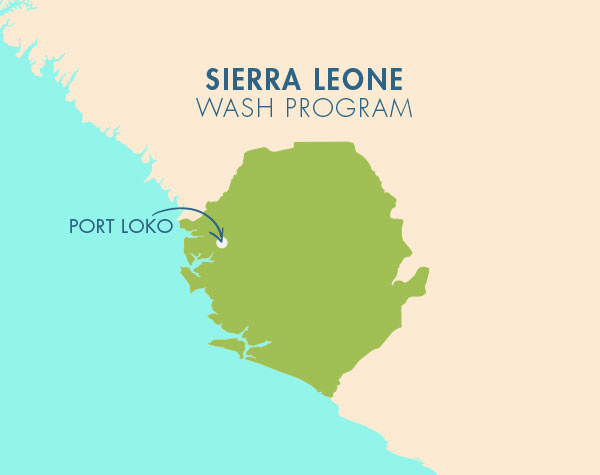
The Water Project’s WaSH program in Port Loko district, Sierra Leone consists of a concentrated network of new, rehabilitated, and maintained water wells. Explore these projects that remain at or near 100% functionality because of quality implementation, customized hygiene, sanitation, and maintenance training, and reliable monitoring, evaluation, and resolution relationships.
A borehole well reaches clean water stored deep underground. We drill down through soil and rock to groundwater that natural layers have already filtered, then build a platform and fit a handpump so families can draw water up close to home. It is a safe, protected source that replaces long walks to open water, and with your partnership it is cared for long after it is installed.
Rehabilitation is not just fixing a pump - it’s total community re-engagement.
There’s only one thing we can think of that might be worse than not having safe water: having safe water, and then losing it because a project fell into disrepair.
Rehabilitation often proves to be a big challenge, as many wells have sit idle for years and there is typically little information about the specifics of the well. A borehole and dug well rehabilitation involves quite a bit of discovery. First, our teams work to discover as much as they can about the initial project. What materials were used? Was the borehole/protected dug well properly constructed? Many of these questions can only be answered by diving in, and doing “the work” which makes up a rehabilitation.
Once our teams have found the problem, they find the solution. Then, they reconstruct the well and install a hand pump.
Engagement and training with communities takes into account rehabilitation was needed and alters the program to suit the needs of the community. After all - engaging with this community in the same way which led to the initial, failed project will not bring new results. Our teams work to understand the social and support reasons leading to initial failure, and make those areas a focus of our ongoing engagement with communities.
Local Leadership
Water projects last because of local leaders. They help us understand the realities on the ground and carry our shared goals to their neighbors. The Water Project identifies and partners with local organizations that share our commitment to water that is reliable, verifiable, and clean. Together we build solutions that belong to the community and keep watch over them for years to come. Your partnership makes that lasting, local work possible.
Community Engagement
The communities we serve are partners in the project, not recipients of it. Long before a single pipe is laid, we sit down with community members to build relationships, plan the project together, agree on how the water point will be managed, and prepare for the ongoing costs of keeping it running. The people who will use the water hold a leading seat at the table. Every project takes real collaboration among many stakeholders, and at each step we hold to the values your partnership makes possible: reliability, relationship, and trust.
Hygiene and Sanitation Training
For many communities, water is only the beginning. When every drop has to be rationed, the things that keep people healthy, like bathing, cleaning, and handwashing, fall away, and where school was out of reach, the basics usually taught in health class were never learned. Water alone can't solve this, which is why your gift also funds hands-on training in every community, school, and health center we serve. We tailor each session to the region, but always cover the essentials: safe water handling and storage, personal and environmental hygiene, how disease spreads, how to form and run a water user committee, and how to operate and maintain the new water point. The goal is simple: to put people back in charge of their own health, so growth and development can begin.
Monitoring and Resolution
Across sub-Saharan Africa, too many wells fall into disrepair and are left behind. Reliability is the true measure of our work, so our commitment does not end when a project is finished. Water can only improve a life if it is there every time, and it can take only one sip of unsafe water to undo months of good health. That is why we measure downtime in hours, not days or weeks, and why every hour a water point is down matters. We monitor every project we have completed to keep the water running. Many donors sustain this work through The Water Promise, a community of monthly partners who keep water flowing long after installation day.
We’re working hard to make sure your gifts result in a lasting water project for the community it serves. Our engagement with a community begins many months before construction and lasts years after construction. The timeline here is focused on the physical construction of the water project. There is also training and engagement work that has already started.
Water project construction in the developing world is hard work. A lot of things can and do cause delays - which are normal. We attempt to make our best judgment of when construction will be complete, but the circumstances surrounding actual "in the field" conditions are far from our control.
Weather, supply availability, government paperwork, and progress of community involvement are just a few of the variables that can delay (and sometimes speed up) a project's completion.
We will always tell you if anything changes. And, if you get a notice like this – it’s actually further proof your gifts are being carefully used towards a water project that lasts.
Click icons to learn about each feature.
Community Profile
The pump at Forikolo DEC Primary School has not provided water for the last five years, leaving the 330 students and six staff members with no option but to leave the school compound multiple times each day in search of water.
First, they try the community well, but they often find it overcrowded or dry due to the drought season from March through April. Their second option, which is not only farther away but much worse in terms of water quality, is the local swamp.
"[The swamp] is located far from the school, and the road leading to this source is a footpath," said 13-year-old student Isatu (in the photo below).
"Sometimes when returning, I [fall] and damage the rubber (bucket) and also get injured. I am afraid to go to the swamp alone. I usually see snakes in the bush when [I] go [to] fetch water at the swamp. This causes me to be afraid and run away," said Isatu.
"As a female teacher, it is my responsibility to make sure that water is at the school for drinking," said 55-year-old teacher Salamatu Turay (in the photo below).
"I also make sure that the sanitation facilities are properly cleaned. It is very difficult to do all these tasks without enough water to use. I have the burden to accompany the students to either the well in the community or the swamp to fetch water in the morning.
"There are a lot of constraints in fetching water, and I am mostly left with limited time to do my job," Salamatu continued. "This disturbs me a lot, especially in trying to complete the academic syllabus before the end of the year. The children are hard to control in the school compound when they need water to drink, and there is no water. All of this limit my teaching time."
Even if the community's main well did not go dry for several months each year, its water is not monitored or treated, and the students would still need to leave school grounds to access it, which is part of the problem.
"[The] water situations affect me greatly because I must miss most of the [class] sessions," Isatu said. "Even the water I fetch is not enough for the class, so during lunchtime, I have to rush home to find water to drink, and I will spend [a lot of] time [at] home [and] this causes me not to return to school earlier. Another aspect of [the] water situation in my school is to practice personal hygiene is a big problem. I would be very happy if this pump is renewed."
When the well on the school grounds is fixed, students' days won't need to be interrupted over and over. They will have more time in class and won't have to trek a long distance to the swamp multiple times a day, which will hopefully give them more zeal for learning.
Note: Our proposed water point can only serve 300 people per day. We are working with the community to identify other water solutions that will ensure all 336 people in the school community have access to safe and reliable drinking water.
Here’s what we’re going to do about it:
Well Rehabilitation
The well marked for this overhaul is dry for a few months every year and needs major work to supply adequate, clean water to the community year round. The pump will be removed, and a hand auger will be lowered inside and powered by a drill team. This hand auger will allow the team to drill several meters deeper to hit a sufficient water column that will ensure the well supplies water throughout all seasons.
As the team drills, casing will be installed, transforming the bottom of this hand-dug well into a borehole. PVC piping will connect this lower system directly to the pump, a construction that we know will also improve the quality of water.
Once this plan is implemented, everyone within the community will have access to safe drinking water in both quality and quantity, even through the dry months.
Hygiene and Sanitation Training
There will be hygiene and sanitation training sessions offered for three days in a row.
After our visit, the hygiene and sanitation trainer decided it would be best to teach community members how to build a tippy tap (a hand-washing station built with a jerrycan, string, and sticks). They will use these tippy taps for handwashing demonstrations, and will also teach about other tools like dish racks and the importance of properly penning in animals.
These trainings will also strengthen the water user committee that manages and maintains this well. They enforce proper behavior and report to us whenever they need our help solving a serious problem, like a pump breakdown.
Project Updates
June, 2023: Forikolo DEC Primary School Well Rehabilitation Complete!
We are excited to share that a safe, reliable water point at Forikolo DEC Primary School in Sierra Leone is now providing clean water to students and neighboring community members! We also conducted hygiene and sanitation training, which focused on healthy practices such as handwashing and using latrines.
"I had to go a long distance to fetch water during my lunch break. The water I manage[d] to drink was not pure because it had been fetched from the swamp. I had to go all the way home to make myself comfortable," said 13-year-old Isata K.
Isata continued, "Today, I am the happiest person in this school because I have been suffering for water for so long because of the water crisis. Now that the water is at my doorstep, all these sufferings are going to be over. I will not [have to] go home to drink and make use of the latrine. I want to express my sincere thanks and appreciation to those who have greatly contributed to the success of this water project."
Isata drinking water from the well.
"The completion of the water system in my school has brought so much happiness to my life. This water point will help me have access to drinking water any time I am thirsty. Also, this water point will help to clean the school latrine regularly because, before this time, the latrine had been a mess," said Isata.
"When I saw the team in my school during their first visit, and they interviewed me concerning the nonfunctional water well in my school, I knew that the problem with water in my school was going to be over one day," said Salamatu Turay, a 55-year-old teacher.
Salamatu continued, "As the only female teacher in the school, the male staff relies greatly on me in terms of hygiene practices. Before this time, access to drinking water was also a problem at the school. Even using the toilet was a big problem at the school. Pupils and staff would have to go to a nearby house to fetch water to drink [or] use the toilet. Now that the water point is complete, all the suffering my colleagues, I, and the pupils have endured is finally over. You've been doing a great job in these communities, schools, and health facilities by providing safe and reliable water for them."
We held a dedication ceremony to officially hand over the well to the community members. Several local dignitaries attended the ceremony, including representatives from Port Loko District Council, the Ministry of Water Resources, and a local pastor. Each official gave a short speech thanking everyone who contributed to the rehabilitation of the water project and reminding everyone to take good care of it. Then, Isata and Salamatu made statements on their community's behalf. The ceremony concluded with celebration, singing, and dancing.
Students celebrating.
Clean Water Restored
The drill team arrived the day before beginning work. They set up camp and unpacked all their tools and supplies to prepare for drilling the next day. The community provided space for the team to store their belongings and meals for the duration of their stay. The following day, the work began.
First, we raised the tripod, the structure we use to hold and maneuver each drilling tool. Next, we measured the well's original depth. We then socketed the pipes and installed a casing.
Drilling.
Finally, we lined up the drill rods and started to drill! We reached a final depth of 19 meters with water at 13 meters. The hand-drill method allowed the team to install the cylinder far below the aquifer so that the community has excellent water access throughout the year.
With drilling complete, we installed screening and a filter pack to keep out debris when the water is pumped. We then cemented an iron rod to the well lining and fixed it with an iron collar at the top.
Yield test.
Next, we bailed the well by hand for three days and flushed it, clearing any debris generated by the drilling process. Finally, we tested the yield to ensure the well would provide clean water with minimal effort at the pump.
As the project neared completion, we built a new cement platform, walls, and drainage system around the well to seal it off from surface-level contaminants. The drainage system helps to redirect runoff and spilled water to help avoid standing water at the well, which can be uncomfortable and unhygienic and a breeding ground for disease-carrying mosquitoes.
At last, we installed the pump and conducted a water quality test. The test results showed that this was clean water fit for drinking!
Installing the pump.
New Knowledge
Before conducting any hygiene training, we called and visited the local water user committee to understand the community’s challenges and lack of sanitation facilities. We shared the findings from our discussions with the committee members to help them make the necessary adjustments before the training began. For example, we identified households without handwashing stations or ones that may need to repair their latrines. With this information, community members worked together to improve hygiene and sanitation at home.
After this preparatory period, we scheduled a time when members from each household using the water point could attend a five-day hygiene and sanitation training. We then dispatched our teams to the school to hold the training.
First, our hygiene team trained the teachers, who then shared the new lessons with the student body with our help.
Training topics covered included handwashing and tippy taps, good and bad hygiene habits, teen pregnancy, worms and parasites, proper dental hygiene, menstrual hygiene, proper care of the well's pump, keeping the water clean, the cost recovery system, the importance of using dish racks and clotheslines, the importance of toilets, keeping latrines clean, balanced diets, the diarrhea doll, and disease transmission and prevention, COVID-19, Ebola, Hepatitis, HIV and AIDS.
A teacher demonstrates the correct way to wash hands using a tippy tap.
A favorite topic covered during the training was malaria or dengue fever; the participants were very engaged during this lesson. Participants were curious to know what causes malaria.
One participant said, "This topic reminds me of the situation that occurred with my son a few months ago. In the morning, my child was very active and healthy. But in the evening hours, he started to manifest the signs and symptoms of malaria: fatigue, fever, shivering, and sweating. The temperature of his body became the worst, and I became worried. I was asking myself, "What really is the cause of this situation?" During that period, it was late, and I didn’t even have money to use for transportation to take my son to the hospital. The nurse advised my wife to take off his clothes, use hot water to heat him, and give him medicine. After some time, my son got better. What my wife did was follow the advice given to her by the nurse at the hospital. I am now taking this opportunity to advise everyone to go to the nearby clinic and abide by their advice by having medication at home in case of an emergency."
Isata added, "First, I want to thank God for such training. As a student, it is an opportunity for me to learn new things that are important to my health issues. The training was very important to me because I have learned a lot about hygiene. Certain things that I took for granted, I now handle with seriousness. I normally play on the ground with bare feet, not knowing that it is dangerous. We can get diseases easily by playing on the ground without washing our hands properly before eating. Although teachers have been teaching us about cleanliness, I still practiced the same thing. I was able to learn today about disease transmission and the negative effects of defecation in the backyard of the house and eating food without washing my hands. I will not allow such things to happen [anymore]."
Conclusion
This project required a substantial collaboration between our staff, our in-country teams, and the community members. When an issue arises concerning the well, community members are equipped with the necessary skills to rectify the problem and ensure the water point works appropriately. However, if the issue is beyond their capabilities, they can contact their local field officers to assist them.
Also, we will continue to offer them unmatchable support as a part of our monitoring and maintenance program. We walk with each community, problem-solving together when they face challenges with functionality, seasonality, or water quality. Together, all these components help us strive for enduring access to reliable, clean, and safe water for this community.
With your contribution, one more piece has been added to a large puzzle of water projects. In Kenya, Uganda, and Sierra Leone, we’re working toward complete coverage. That means reliable, maintained water sources within a 30-minute round trip for each community, household, school, and health center. With this in mind, search through our upcoming projects to see which community you can help next!
Thank you for making all of this possible!
May, 2023: Forikolo DEC Primary School Well Rehabilitation Underway!
A severe clean water shortage at Forikolo DEC Primary School drains students’ time, energy, and health. Thanks to your generosity, we’re working to install a clean water point and much more.
Get to know this school through the introduction and pictures we’ve posted, and read about this water, sanitation, and hygiene project. We look forward to reaching out with more good news!


 Borehole Well and Hand Pump